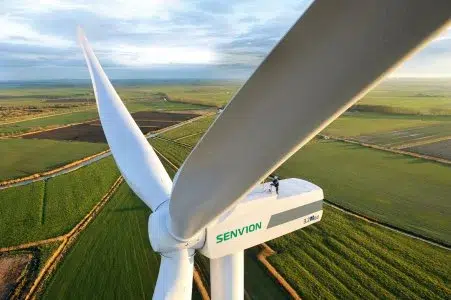
Senvion India has announced that its 4.2M160 wind turbine model has been included in the Ministry of New and Renewable Energy (MNRE) Approved List of Models and Manufacturers (ALMM) – Wind, issued on 30 December 2025.
The listing marks a key regulatory milestone, enabling the deployment of the 4.2M160 turbine in wind energy projects across India in full compliance with MNRE norms.
Understanding the ALMM (Wind) Framework
The ALMM (Wind) framework, earlier known as the Revised List of Models and Manufacturers (RLMM), is designed to streamline model qualification, strengthen quality assurance, and promote localisation of wind turbine manufacturing in India.
Recent updates to the framework place greater emphasis on domestic manufacturing and supply-chain resilience, aligning with India’s broader clean energy and self-reliance objectives.
Turbine Specifications and Compliance
The Senvion 4.2M160 wind turbine features:
- Rated capacity: 4.2 MW
- Rotor diameter: 160 metres
- Approved hub heights: Up to 140 metres
With the ALMM approval in place, the turbine is now eligible for deployment in MNRE-compliant wind projects, including utility-scale and commercial developments.
Order Book and Market Acceptance
Senvion India has already secured firm orders exceeding 600 MW for the 4.2M160 platform. In addition, the company has signed a long-term framework agreement for 2 GW of capacity to be executed over a three-year period.
The order pipeline reflects growing customer confidence in higher-capacity wind turbine platforms designed for India’s evolving wind resource and land constraints.
Made-in-India, High-Performance Technology
The 4.2M160 turbine has been designed, engineered, and industrialised in India, with localisation levels exceeding 85 percent. The manufacturing ecosystem spans blades, towers, nacelles, and hubs, supported by a pan-India supplier network.
Key technology features include:
- 78.5-metre ReT blades with advanced lightning protection
- High derating thresholds up to 45°C, enabled by a hybrid active–passive cooling system
- Single-blade installation capability, improving project execution across varied terrains
- FleetPro® SCADA system with real-time monitoring, predictive analytics, and grid and cybersecurity compliance
- AI-enabled adaptive controls to enhance energy capture in low-wind conditions
These features are aimed at improving project economics, reliability, and long-term performance under Indian site conditions.
Leadership Perspective
Commenting on the ALMM listing, Amit Kansal, CEO & Managing Director of Senvion India, said the approval represents an important milestone in the company’s commitment to India’s clean energy manufacturing ambitions.
He highlighted that the 4.2M160 platform strengthens the domestic value chain, expands local production capacity, and supports India’s long-term energy security goals through deep localisation and supply-chain integration.
Why This Matters
ALMM approval is a critical requirement for wind turbine deployment in many government-backed and utility-scale projects in India. The inclusion of higher-capacity turbines like the 4.2M160 supports:
- Faster scaling of wind capacity with fewer turbines
- Improved land-use efficiency
- Higher energy yields at low- and medium-wind sites
- Stronger domestic manufacturing and supply chains
Such developments are essential as India targets accelerated wind capacity additions over the coming decade.
Industry Outlook
India’s wind energy sector is transitioning toward larger rotor diameters and higher-capacity turbines to optimise project economics and improve performance in diverse wind regimes. Policy frameworks such as ALMM are expected to further encourage domestic manufacturing and technology upgrades.
Manufacturers offering highly localised, grid-compliant, and climate-resilient turbine platforms are likely to play a key role in the next phase of wind energy growth.
Related News
Read more wind energy and renewable manufacturing updates on Renewable Time.