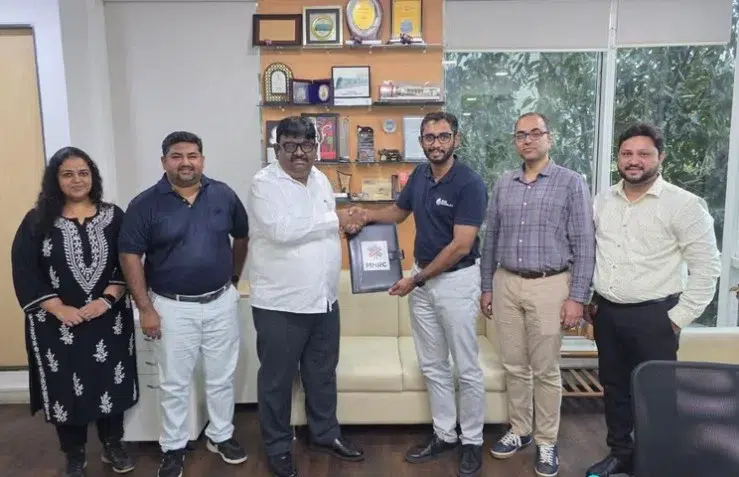
Indofast Energy has announced a strategic partnership with Mumbai Metro Rail Corporation Limited (MMRCL) to deploy a network of 23 battery swapping stations along the Aqua Line 3 corridor of the Mumbai Metro. The initiative marks a significant step toward strengthening Mumbai’s electric vehicle (EV) infrastructure and advancing integrated urban mobility.
Under the agreement, battery swapping stations will be installed across eight key metro locations, including Aarey JVLR, SEEPZ, MIDC, Santacruz Metro, Bandra Kurla Complex (BKC), Dharavi, Worli, and Acharya Atre Chowk. These locations lie along Mumbai’s critical north–south transit corridor and are expected to serve high commuter density as well as last-mile delivery and shared mobility requirements.
Integrating Mass Transit with EV Infrastructure
The deployment is designed to support electric two-wheelers, three-wheelers, and small commercial vehicles, enabling fast and convenient battery exchanges for daily commuters, gig workers, and logistics operators. By integrating battery swapping infrastructure with metro stations, the initiative aims to address key EV adoption challenges such as charging time, range anxiety, and access to reliable energy infrastructure in dense urban environments.
Battery swapping stations will be equipped with Indofast Energy’s automated swapping technology, allowing multiple vehicle types to operate on a single standardized battery platform. This approach enhances interoperability, reduces downtime for EV users, and improves asset utilisation for fleet operators.
The partnership reflects a broader shift in urban transport planning, where mass rapid transit systems are being complemented by clean, flexible last-mile mobility solutions.
Strengthening Mumbai’s EV Ecosystem
Mumbai is among India’s most densely populated metropolitan regions, where last-mile connectivity plays a crucial role in daily commuting. Linking metro infrastructure with EV battery swapping is expected to make electric mobility more practical for short-distance travel, delivery services, and feeder transport to metro stations.
By enabling quick battery replacement instead of long charging cycles, battery swapping supports high-usage vehicles such as delivery two-wheelers and three-wheelers, which are central to urban logistics and shared mobility ecosystems.
The Aqua Line 3 project, connecting south and north Mumbai, is seen as a backbone for future transit-oriented development. The addition of EV energy infrastructure along the corridor enhances its sustainability profile and aligns with Mumbai’s broader climate and emissions reduction goals.
Indofast Energy’s Growing Footprint
Indofast Energy has been steadily expanding its battery swapping network across major Indian cities. The company currently operates 19 battery swapping stations in Mumbai, including its 1,000th battery swapping station located at Lokmanya Tilak Terminus, highlighting the scale and maturity of its deployment model.
The new installations along Metro Line 3 will further consolidate Indofast Energy’s position as a key player in India’s battery swapping ecosystem, particularly for urban mobility and public transport-linked use cases.
Industry observers note that partnerships between EV infrastructure providers and public transit authorities are becoming increasingly important as cities look to decarbonise transport without compromising efficiency or accessibility.
Leadership Commentary
Commenting on the collaboration, Anant Badjatya, CEO of Indofast Energy, described the initiative as a “paradigm shift in urban mobility planning.” He noted that integrating battery swapping with metro infrastructure can significantly accelerate EV adoption by making clean mobility more convenient and accessible for everyday users.
From the metro authority’s perspective, R Ramana, Director (Planning) at MMRCL, stated that the deployment would encourage more commuters to shift to electric vehicles for short-distance and feeder travel, complementing the city’s mass transit network.
Enabling a Cleaner Urban Transport Future
The collaboration aligns with India’s broader push toward electrification of transport, reduction of urban air pollution, and development of smart, sustainable cities. Battery swapping is increasingly seen as a viable alternative to conventional charging, especially for high-frequency urban mobility use cases.
As Mumbai continues to expand its metro network and EV ecosystem, initiatives such as this partnership are expected to play a critical role in shaping integrated, low-emission urban transport systems.
The Indofast Energy–MMRCL collaboration sets a precedent for other metropolitan regions looking to combine public transport infrastructure with scalable EV energy solutions.
For more renewable energy, EV infrastructure, and clean mobility news, visit RenewableTime.