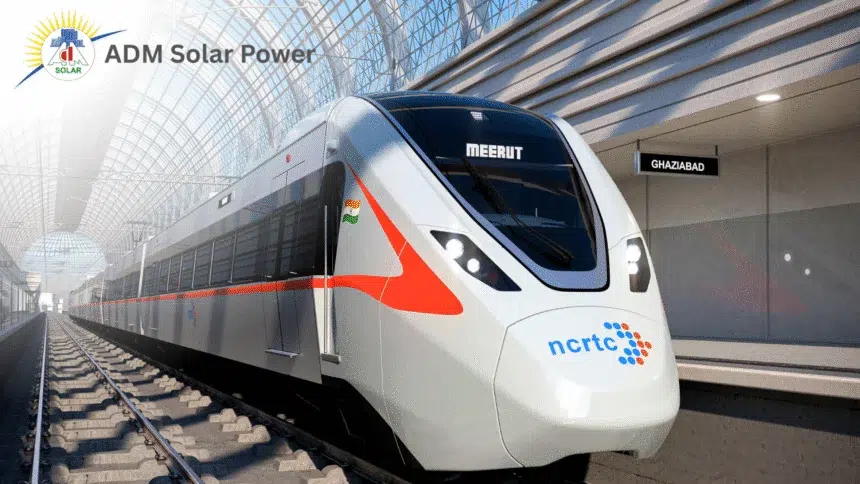
ADM Solar has partnered with National Capital Region Transport Corporation (NCRTC) to solarize the Namo Bharat Corridor, marking an important step toward integrating renewable energy into India’s next-generation public transport infrastructure.
Under the partnership, ADM Solar will develop a 3.0 MWp rooftop and car parking solar power project across seven stations on the Delhi–Ghaziabad–Meerut corridor, India’s first semi-high-speed regional rail system.
Project Overview
The solarization project will be implemented across key Namo Bharat stations located in Delhi, Ghaziabad, Meerut, and Modinagar, enabling on-site clean energy generation for station operations.
Key project details:
- Installed capacity: 3.0 MWp
- Project type: Rooftop & car parking solarization
- Stations covered: 7 Namo Bharat stations
- Execution model: RESCO (Renewable Energy Service Company)
- PPA tenure: 25 years
- Client: NCRTC
- Developer & operator: ADM Solar
The stations identified include Sarai Kale Khan, Jangpura, New Ashok Nagar, Rithani, Pratappur, Shatabdi Nagar, and Modupuram.
RESCO Model and Scope of Work
The project will be executed under the RESCO model, ensuring zero upfront capital expenditure for NCRTC. ADM Solar will be responsible for the entire project lifecycle, including:
- Design and engineering
- Supply and installation of solar systems
- Testing and commissioning
- Comprehensive operation and maintenance over 25 years
This structure enables long-term cost savings while ensuring system performance and reliability throughout the contract period.
Technology Deployment
ADM Solar will deploy 550 Wp mono-facial solar PV modules, selected for their high efficiency and consistent energy output. The combination of rooftop installations and car parking solar structures will ensure optimal space utilisation while generating clean power directly at the point of consumption.
The solar systems are designed to support the operational energy needs of Namo Bharat stations and reduce reliance on conventional grid electricity.
Supporting Sustainable Public Transport
Once commissioned, the 3 MW solar installation is expected to:
- Lower the carbon footprint of Namo Bharat operations
- Reduce dependency on grid-based power
- Deliver long-term energy cost savings
- Strengthen the sustainability profile of regional rail infrastructure
Embedding renewable energy into public transport assets aligns with India’s broader clean mobility and climate objectives.
Why This Matters
The Namo Bharat Corridor represents a new generation of regional rail connectivity in India. Integrating solar energy into such infrastructure highlights the growing role of renewables in:
- Decarbonising public transport systems
- Improving energy efficiency of large infrastructure assets
- Demonstrating scalable clean energy adoption for government projects
Projects like this serve as reference models for future transport-led renewable energy deployments across the country.
Industry Outlook
As India expands metro, regional rail, and high-speed rail networks, demand for on-site renewable energy solutions is expected to grow rapidly. Rooftop and car parking solar installations are emerging as practical options for rail stations due to space availability and predictable daytime energy demand.
Solar EPC and RESCO players with experience in long-term institutional projects are likely to see increasing opportunities as transport authorities prioritise sustainability and lifecycle cost optimisation.
Related News
Read more renewable energy and sustainable infrastructure updates on Renewable Time.