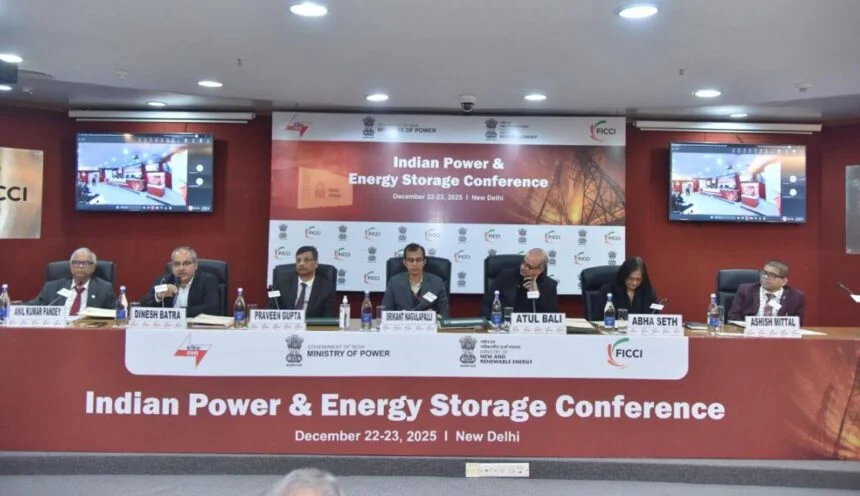
India’s power sector is entering a decisive phase where the success of the energy transition will depend not only on renewable capacity addition, but on how effectively the country strengthens energy storage, grid flexibility, and policy execution. This central message emerged from the Indian Power & Energy Storage Conference 2025, organised by FICCI in New Delhi, bringing together senior policymakers, regulators, utilities, and industry leaders.
Supported by the Ministry of Power, Ministry of New & Renewable Energy (MNRE), and the Central Electricity Authority (CEA), the conference served as a strategic platform to discuss the evolving challenges of managing a rapidly transforming power system while ensuring reliability, affordability, and long-term sustainability.
From Capacity Expansion to System Sustainability
India today has an installed power generation capacity exceeding 500 GW, making it the world’s third-largest electricity producer. However, the sector’s priorities are undergoing a fundamental shift. While renewable energy sources now account for over 50 per cent of installed capacity, thermal power plants continue to generate nearly 70 per cent of actual electricity, underlining their continued importance in maintaining grid stability.
Speakers at the conference emphasised that the next phase of India’s energy journey must focus on system-level resilience, rather than capacity expansion alone.
“India’s energy transition is not just about climate action,” said Srikant Nagulapalli, Additional Secretary, Ministry of Power. “It is equally about energy independence, affordability, and supporting rapid economic growth as we move towards 2047.”
Policy Reforms and Digital Enablers
Nagulapalli highlighted that upcoming reforms under the Electricity (Amendment) Bill aim to address structural inefficiencies in the power sector. Proposed measures include improving distribution performance, strengthening electricity markets, and optimising the utilisation of generation and transmission assets.
He identified data analytics, artificial intelligence-driven grid management, and performance-linked incentives as critical enablers for building a stable and future-ready electricity system capable of absorbing large volumes of renewable energy.
Distribution Sector in the Spotlight
The distribution sector emerged as one of the most discussed themes at the conference, with speakers underscoring its role as the financial backbone of the power ecosystem.
“Technology is transforming the distribution sector,” said Atul Bali, Director, National Smart Grid Mission. “Smart metering and smart grids are already delivering measurable improvements in billing efficiency, revenue realisation, and consumer empowerment.”
According to experts, large-scale rollout of smart meters and digital monitoring tools is helping utilities reduce losses, improve transparency, and enable time-of-day pricing—an essential feature for integrating renewable energy and storage solutions.
Thermal Power’s Evolving Role
As renewable penetration increases, thermal power plants are being asked to operate more flexibly to balance variable generation from solar and wind. However, speakers cautioned that flexibility must be implemented carefully.
“Flexible operation of thermal power plants is becoming unavoidable,” said Praveen Gupta, Member (Thermal), CEA. “But it must be done in a manner that protects plant health and ensures long-term asset viability.”
Balanced planning across generation, transmission, and storage infrastructure was identified as essential to avoid technical stress and stranded assets.
Industry Concerns Over Asset Stress
Industry representatives voiced concerns about the operational and financial pressures facing existing generation assets, particularly coal-based plants.
“Thermal power remains the backbone of India’s electricity system,” said Dinesh Batra, Co-Chair, FICCI Power Committee and EVP, Hindustan Power Projects. “However, increasing flexibility requirements are placing significant technical stress on assets that were not originally designed for such operations.”
He called for market mechanisms and policy frameworks that ensure fair compensation for flexibility services while enabling smoother renewable integration.
Energy Storage as the Missing Link
Energy storage emerged as a central theme throughout the conference, with consensus that it is the critical missing component for achieving grid stability and maximising renewable energy utilisation.
“Energy storage is essential for addressing peak demand challenges and unlocking the full value of renewable energy,” said Anil Kumar Pandey, Advisor, Jindal Power Limited. He urged policymakers to introduce targeted incentives, rationalised transmission charges, and long-term visibility to accelerate storage deployment.
Battery storage, pumped hydro, and emerging long-duration storage technologies were discussed as key tools to manage intermittency and reduce reliance on fossil fuel-based peaking power.
Market Reforms and Financial Sustainability
Analysts highlighted that policy clarity, technology adoption, and financial sustainability must advance in parallel.
“India’s power sector is clearly at an inflection point,” said Ashish Mittal, Director – Energy & Commodities, CRISIL. “Digitisation, real-time power markets, renovation of ageing assets, and flexible operations will be critical to meeting India’s evolving demand-supply dynamics.”
Experts noted that without financially healthy utilities and predictable market structures, investments in storage and grid modernisation could face delays.
Roadmap Towards Viksit Bharat @2047
The conference concluded with a strong consensus on the need for policy–industry collaboration, storage-led flexibility, market-based reforms, and technology-driven transformation. Participants agreed that these elements are essential for building a resilient, reliable, and future-ready power ecosystem aligned with India’s Viksit Bharat @2047 vision.
As India balances rapid economic growth with climate commitments, the discussions at the FICCI conference highlighted a clear reality: the energy transition’s next chapter will be written not just by renewables, but by how effectively the country integrates storage, flexibility, and smart system planning into its power grid.